

Djed Spence is an unlikely hero for England’s World Cup team. He didn’t score a dramatic game-winning goal nor sacrifice his body to defend his own net. But the people lauding him might not have watched so much as a highlight from England’s games. They were mostly interested in a pre-game handshake.
Before England played Ghana last week, Spence did not shake hands with Ghanaian midfielder Thomas Partey.
Partey is charged with rape and sexual assault in London. He pled not guilty, and will stand trial in June 2027. Ahead of England’s game against Ghana, English commentators, journalists, and politicians called for the English Football Association to direct or encourage players to not acknowledge Partey pre- or post-game; or, failing that, for the English players to snub him on their own.
Alicia Kearns, a Conservative member of Parliament, posted on X: “Good on Djed Spence for refusing to shake [Partey’s] hand - that showed conviction and recognises the seriousness of the charges.” It’s ironic that she chose the word “conviction” to describe Spence, when a conviction is precisely what Partey has not had.
Partey was the second professional athlete denied his presumption of innocence on his sport’s largest stage in June.
During the Stanley Cup finals, Carolina Hurricanes fans booed and chanted “no means no” at Las Vegas Golden Knight’s goaltender Carter Hart. Hart was one of five Canadian hockey players acquitted of sexual assault last summer.
If it was just the opposing team’s fans doing this, we could chalk it up to the beer-and-banter that fuels most fandoms. But in the run-up to the finals, The Athletic put the trial back in the headlines by asking Hart about it at his media availability. The Golden Knight’s press officer ended the press conference there, giving The Athletic their dream story about how the “shield stopping [Hart] from answering questions — not just about his past, but his present and future — is likely to stay in place.”
A headline from the Canadian Broadcasting Company the same week set a new standard for non sequitirs: “1 year after acquittal in Hockey Canada sexual assault trial, Carter Hart could win Stanley Cup.” A broadcast from the CBC laundered the Carolina fans’ taunts into a triumph of allyship: “Carolina Hurricanes fans expressing what many survivors of sexual assault say they’re feeling watching goaltender Carter Hart.” They then cut to an activist lamenting that the NHL is “not holding anyone accountable” in the wake of a judicial exoneration. The name of that activist’s organization says it all: “Beyond the Verdict.”



We can only wonder how the CBC would retcon Boston Red Sox fans chanting “Darrrrrrrr-yl” at the Mets’ Darryl Strawberry.
Strangers on a Team Bus
The Athletic’s antics at the Stanley Cup were just their warm-up, though. The Athletic dispatched a reporter to Ghana’s training camp at Bryant University in Rhode Island. Jordan Campbell’s description of Ghana’s team bus arriving for their first training session establishes Campbell as the leading light of moral panic noir.
Cue the tenor saxophone’s slouching arpeggio:
“It was a silent cavalcade. The siren lights were on but no alarm sounded. Meanwhile, a teenage girl passed by, seemingly oblivious to the new guests as she walked across the car park towards the Track and Turf Complex to a hockey event.”
Campbell reports that “Partey came into close contact with several children during a ‘Community Day’” event open to the public. He substantiates that statement with a photo of Partey, two other players, and a staff member interacting with a group of children. Also in the photo: a uniformed police officer staring directly at the group.
Campbell cites Bryant University’s failure to enforce Ghana’s “private and secure area,” relaying how “dozens of school girls [walked] unattended across the car park area, including a section inside the off-limits area.” To illustrate the apparent danger, The Athletic included a satellite photo of the campus showing the “off-limits areas” and the athletics facilities being used by unsuspecting youth and collegiate athletes.
I would be remiss if I didn’t take a swipe at Campbell, The Athletic, and its parent company The New York Times by noting that Bryant University is 73% white. If we wanted to be as ungenerous as Campbell, we could place this article in the context of the United States’ desultory and sometimes horrific history of sexualized fear-mongering about black men preying on white women.
That aside, Campbell’s over-stylized prose exemplifies the extent to which both sides of the Anglo-American tradition have come to despise the presumption of innocence. Campbell almost explicitly says as much. He describes the relative normalcy of Partey’s participation in his national team’s activities as “a jarring juxtaposition that highlights how complicated safeguarding decisions can be in situations such as Partey’s where he has not been convicted of anything and strongly insists he is innocent.”
It’s actually straight-forward and simple: Partey has not been convicted of anything, whether he strongly insists on it or stays mum. It’s not up to him to say, let alone prove, anything.
Culture should protect the law
The online discourse against Partey and Hart has degraded a principle that has spanned millennia into the new “just asking questions.” Anyone trying to temper the rush to condemn these men will be preempted by shrill sneering: “Oh let me guess: innocent until proven guilty. You know that’s just in the courtroom, right?” Or “not guilty doesn’t mean innocent!”
Similar to the First Amendment, the presumption of innocence is being reduced to a matter of “black letter law.” It applies only in the courtroom, where it increasingly is seen as a technicality—an obstacle towards someone’s desired outcome rather than a fundamental of everyone’s rights and liberty.
Restricting the presumption of innocence to the courtroom and dismissing it in society “is more than a departure from the Anglo-American tradition,” François Quintard-Morenas wrote. “It challenges the very foundation of a social contract in which society… acknowledges that there is a time for innocence and a time for guilt.”
Those are the only two choices. If the accused is not found guilty, the only other state they could be is their baseline, natural, presumed state: innocent.
I can write about the presumption of innocence and the judicial system as the gold standard, and still say, “O.J. did it.”
We are not the first society to smear the binary of innocence-or-guilt into a spectrum. Discussing pre-revolutionary France, Quintard-Morenas describes how accused individuals denied their presumption of innocence lived in a purgatory closer to hell than to earth. “Neither perfectly innocent nor entirely guilty, they suffered the stigma reserved to convicted criminals.”
The presumption of innocence does not mean we suppress or abdicate our individual judgment and wait for the courts to make up our minds for us.
Like any well-formed right, the presumption of innocence imposes a responsibility. In a culture of the First Amendment, for example, we do not try to shut (or shout, or shoot) down speech we don’t like. We engage when we want to, and tune out when we don’t, but we leave each speaker and listener free to be.
In a culture of the presumption of innocence we demand and respect evidence. Each person must evaluate the evidence offered in support of the accusations before deciding—and maybe publicly declaring—that the accused is guilty.
Hence, I can write about the presumption of innocence and the judicial system as the gold standard, and still say, “O.J. did it.”
But we have to know what to evaluate, and how.
Notice what Alicia Kearns, MP, said in her X post above. Spence “recognises the seriousness of the charges” (emphasis added). Not the strength of the evidence, but the seriousness of the charges.
Similarly, The Athletic’s Campbell and others use the number of accusers and charges against Partey as evidence of wrongdoing or the danger he poses. The Athletic’s Dan Sheldon relies on “multiple reports” to execute the same playbook against Cape Verde’s team captain, Ryan Mendes. None of them weigh the credibility of the accusations nor the validity of any of the evidence presented. They conflate repetition with evidence.
But accusations are not evidence. Accusers are not evidence. Reports in foreign media are not evidence. No matter how many there are, they do not prove one another.
Every digital space is a global town square. Every post is a pillory. Every insult is preserved until it becomes an epitaph.
Quintard-Morenas cites a French legal text from the mid-eighteenth century: “Public opinion forms a considerable part of the punishment. It prolongs its duration, [and] renders the reparation of the innocent almost impossible.” If that was true then, think about how much worse it is today in our era of instant, worldwide communication. Every digital space is a global town square. Every post is a pillory. Every insult is preserved until it becomes an epitaph.
Carter Hart was acquitted. Partey has been charged but not tried. Mendes is accused but not charged. They and others like them span the spectrum of ways in which one’s presumption of innocence remains intact—that is, they are innocent because they have not been proven guilty. For them as well as those who were targeted by a mob for transgressions far below the criminal threshold, public opinion is the punishment.
Principles only last for 4,000 years if they benefit individuals and society. Hammurabi put the presumption of innocence into his Code, so it predates even him. It will sometimes be dormant, but never dead.
We should not wait for history to cycle through a round of tragedies before we reclaim what we surrendered. Regardless of jerseys or flags, we should strive to shake hands on that.
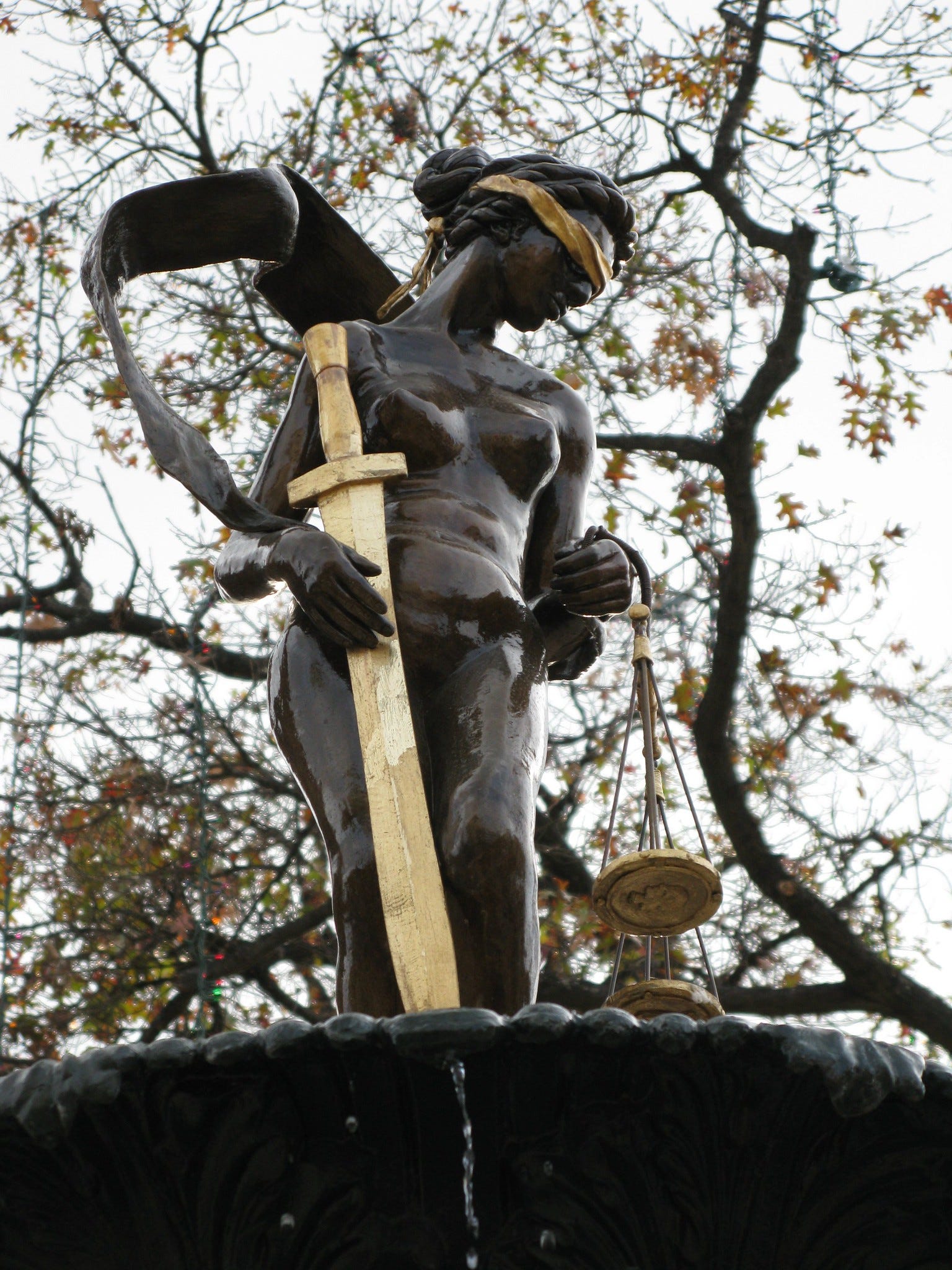
Photo credit: frankieleon / Flickr, under CC BY 2.0.
George, thank you. Another great column and timely reminder of our fundamental value: each is innocent until proven guilty.
“But accusations are not evidence. Accusers are not evidence.”
Sadly, the MeToo ‘movement’ effectively said the opposite. And a whole bunch of people listened. Remember “Believe the woman” ?
I’m actually ashamed to have had a novel associated with MeToo.
Thanks for the solid article, George. Peace.