

“How is this even legal?”
I’ve been asked some version of that question by lawyers, athletes, coaches, parents, authors, journalists, men, women, Americans, Germans, Moroccans, Canadians… The most recent was someone I talked to within a few hours of him receiving his notice of “temporary” sanction and pending investigation from the US Center for SafeSport. After reading the letter, his thoughts did not drift towards the writings of Franz Kafka, as they should have. He thought of the United States Constitution, and the principles that ostensibly run through both our culture and our law. And so he asked not “Is this for real?” but “How is this legal?”
Over the next week or so, I’m going to publish two articles about the Fourth Circuit Court of Appeals’ decision in Navarro et al. v. US Center for SafeSport et al. One will pound the law and the other will pound the facts around some of the legal and constitutional issues.
This article is like The Hobbit for those two: a standalone prequel. If this is all you read, great. But if you read the other two, this one lays some solid groundwork.
It will stay in the realm of Kafka: things too absurd to believe they are true, but they are. The first one, in particular, like the proverbial whack-a-mole, will keep popping up to pound in the context of the Navarro ruling.
Anti-social distancing
Among the sanctions the Center can impose upon a sports person per the SafeSport Code are “no contact directives.” Several “Notices of Decision” that I have reviewed use the following (NB: in SafeSportSpeak, “respondent” is the accused and “claimant” is the accuser):
Respondent is prohibited from communicating in any way with Claimant. Communication includes, but is not limited to: contact by phone, through email or text message, via any social media application or other electronic medium, in-person interactions (verbal and non-verbal), or contact facilitated through a third party. Should Respondent and Claimant happen to be in the same place at the same time, in addition to refraining from any form of communication, Respondent should make reasonable efforts to keep their distance avoid getting too close to Claimant.
It’s essentially a restraining order. “No contact directives” can be part of temporary or permanent sanctions, which means a person could be prohibited from communicating with the other person for life.
On July 7, 2026, 285 individuals listed on the Centralized Disciplinary Database were under a no contact directive.
Turning paddocks into prison yards
Fun fact: Equestrian is both the name of the sport and the word for people who compete in the sport. Equestrians compete in equestrian. Equestrian is full of equestrians. Uma, Oprah…
Grim fact: When the US Center for SafeSport sanctions someone in that sport, the sins of the equestrian fall upon the equine.
Log in to the US Equestrian Federation’s website and select “Ineligibility List,” and then you can select “Individuals / Organizations” or “Horses.” Obviously, the banned horses did nothing wrong (they’re good horses, Brent). They are on the list because of their owners or trainers. Some are there because their owners or trainers doped them, or violated other rules relating to performance-enhancement. In those cases, we can understand why the horse is banned on the basis of competitive fairness.
But some horses—like Casablanca, Gianna, Je Ne Sais Pas, and Quick Step—are banned because their owners have been banned by the US Center for SafeSport.
To minimize abuse, black market transactions and trafficking (seriously—if anyone can get me in touch with Mariana van Zeller, I’ve got a tip for her), and various forms of cheating, equestrians maintain a continuous chain of ownership and custodial paperwork. A key component of these transactions is a microchip in each horse’s neck, similar to the ones every responsible dog owner should have in their dog.
While they may be getting the Russian oligarch treatment, these aren’t rich people. These are small business owners who have all of their worth and assets tied up in their business.
If an equestrian in USEF is interested in buying a horse, the basic due diligence is looking up the horse on the USEF’s registry. If the horse is suspended, the registry puts a solid vertical red bar next to the horse’s profile. From there, they can look up the owner to see if he or she is banned. Once the prospective buyer has that information, if they conduct the transaction and buy the horse from the banned individual, they have committed “Aiding and Abetting” per the SafeSport Code. Given the strict record-keeping involved, they would be creating the paper trail that unequivocally establishes their violation of the Code.
Alternatively, they could buy the horse and not change its formal registration with the federation and on the microchip, but then they wouldn’t be able to enter the horse into any sanctioned competition (which is pretty much all of them, and all the ones with decent money). Moreover, even if they drew up a contract for the sale, they’d be setting themselves up for ownership disputes down the road.
And if you transfer the horse to your spouse’s name, that will result in your spouse joining you and the horse in the ol’ Gray Bar Stables.
The chilling effect of getting caught is as powerful as the administrative checks that impede such sales.
Equestrians, therefore, essentially have their assets frozen through the US Center for SafeSport.
Equestrians that I’ve spoken to have had individual horses worth $15,000–$250,000. The total value of the horses in their stable can quickly enter seven figures. And while they may be getting the Russian oligarch treatment, these aren’t rich people. These are small business owners who, like any small business owner, are relatively cash poor because they have all of their wealth and assets tied up in their business.
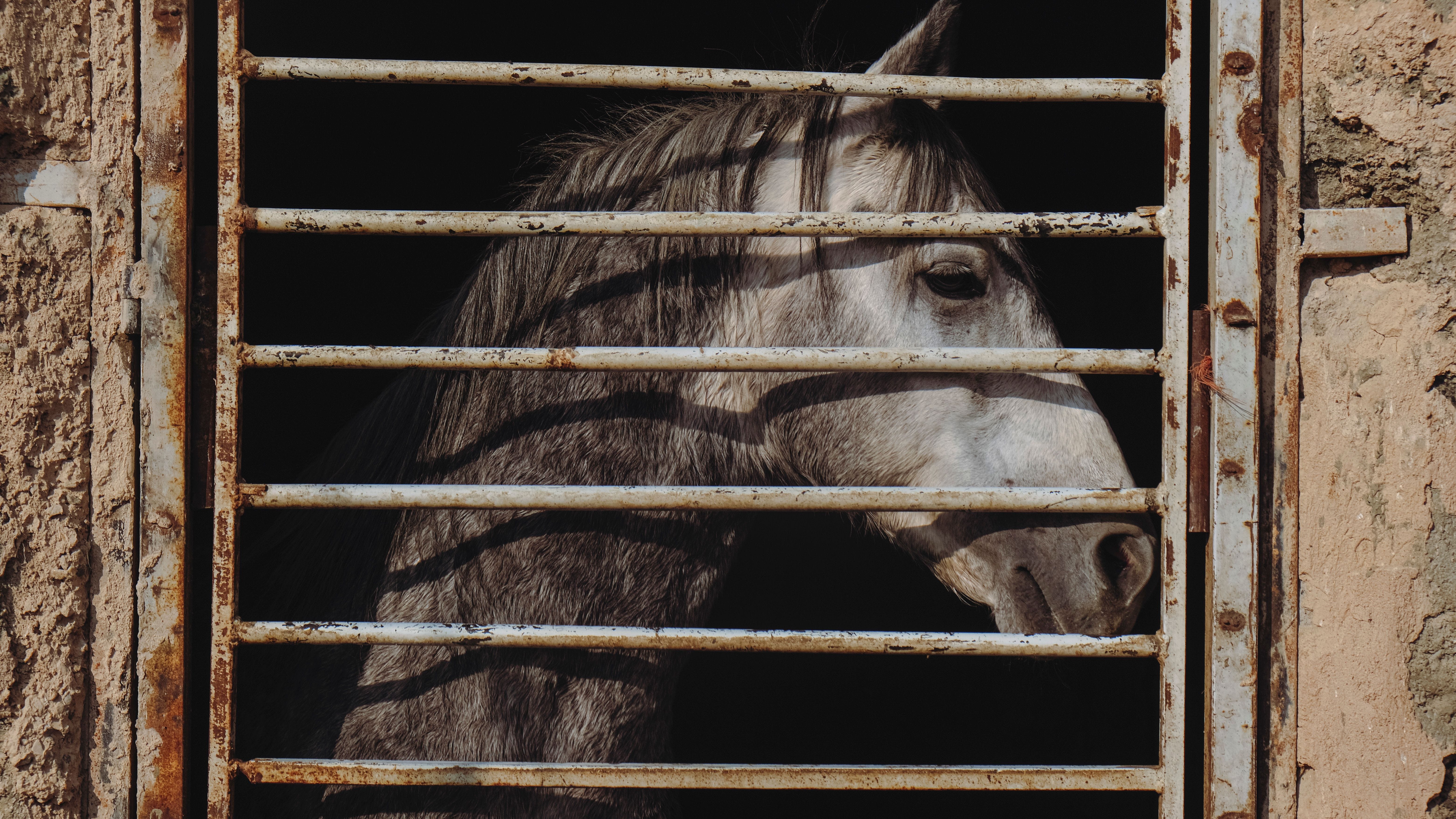
Upon being banned, the equestrians can’t make money from their horses by entering them into shows and competitions, nor can they convert these assets into cash by selling them. But they obviously have to take care of them. The downward financial spiral of this “irreversible business death sentence” is staggering. It’s compounded by the emotional toll of the bond these equestrians have with their horses. They don’t want to part with their horses, but they want what’s best for them. Yet they are prohibited from taking the difficult but necessary step of selling them in anything other than a back alley transaction—one that will still leave the horse a toxic asset.
Non-membership has its privileges
You don’t need to be a member of USA Swimming to attend the national championship swim meet each year, nor do you need to be a member of USA Track & Field to get a few laps in on the indoor track at the Armory in New York City’s Washington Heights during it’s public-use hours. You don’t need to show your US Equestrian Federation card to enjoy an Aperol Spritz at the Winter Equestrian Festival at Wellington International. And you definitely don’t need to be a member of US Soccer or US Hockey to watch your kid’s league games in your own town.
But if you have been banned by the US Center for SafeSport, you are not allowed to be at any of those events or places, and—if spotted by the wrong kind of person—you may be asked to leave.
A ban from the US Center for SafeSport means you cannot “participate until further notice, in any capacity, in any program, activity, Event, or competition sponsored by, organized by, or under the auspices of the USOPC, any NGB, or any LAO, or at a facility under the jurisdiction of the same.”
“[A]ny capacity” includes spectator, even when your function at that event is “Mom.” Technically, you shouldn’t even be watching national championships and other covered events on TV or livestream.
With an eye to the upcoming articles, let’s make this asymmetry explicit. You don’t need to be a member to enter these public places and take part in public events, many of which don’t require tickets and don’t even have doors. But if you are “ineligible” per the Center, you cannot.
Herd immunity
Now you call me “amoral,”
A “dangerous disgrace,”
If you’ve got something to say
Name a time and place
Face to face
- Hamilton: An American Musical
Alexander Hamilton and Aaron Burr met at Weehawken because Charles Cooper wrote in a private letter that was later published that Hamilton held “a still more despicable opinion” of Burr than what was already in the public sphere.
Jump forward to 1971, when the Supreme Court held that the state of Wisconsin branding Norma Constantineau as, basically, an irresponsible, kinda trashy drunk was a constitutionally actionable “stigma or badge of disgrace.” The Supreme Court affirmed the state court’s ruling that “[i]t would be naive not to recognize that such ‘posting’ or characterization of an individual will expose him to public embarrassment and ridicule.” The Court spent very little time on the question of whether publicly listing Constantineau as a suboptimally functioning alcoholic violated her interest in her “good name, reputation, honor, or integrity.” It was just that obvious.
Jump once more to last month, when a federal judge in Illinois determined that there is an “innocent construction”—a term of art in defamation law that I’ve written about here—to calling someone a pedophile.
She cites Wikipedia’s characterization of the “popular usage” of the term in support of that conclusion.
Not every litigant will have a judge who is so very online that she groks “whatevs pedo” and “ok groomer” are nbd. Except out here IRL, calling someone a pedophile is career- and life-ruining, particularly in certain lines of work (like my other one). In the post-Larry Nassar, post-MeToo, post-Epstein world, it’s hard to think of any worse epithet to attach to a man: not in a shit-posting 8chan way, but in a serious, sober, public way.
If reputation has any meaning, no, I don’t condone duels, “But your man has to answer for his words, Burr.”
But let’s give the judge the benefit of the doubt, on the grounds that our civic discourse is as degraded as our right to reputation: you can call someone a pedophile and it doesn’t really mean anything, but even if it did, who cares, good luck with your defamation suit, pedo.
Instead, we’ll change the accusation to: “You did the same thing as convicted child sex offender Larry Nassar.”
Larry Nassar’s entry on the US Center for SafeSport’s Centralized Disciplinary Database says “Criminal disposition – involving a minor.”
A criminal disposition per the SafeSport Code is “any disposition or resolution of a criminal proceeding, other than an adjudication of not guilty[.]” The Code has a separate violation for “Criminal Charge.” However, not a single person is currently on the Centralized Disciplinary Database for having a “Criminal Charge.”
Many who are listed under “Criminal disposition,” though, have only been charged. Some of them have since had their charges dismissed, but remain on the list.
Nor does it specify the nature of the offense. Some of the people listed as “Criminal disposition – involving a minor” are there because they were charged with DUI with a minor in the car. And yet that person is branded in the exact same way as the man convicted of and serving the rest of his life in prison for hundreds of sexual assaults against minors.
The Centralized Disciplinary Database is inescapably defamatory.
No normal 501(c)3 would be so brazen, stupid, or self-destructive to bill themselves as a sexual abuse watchdog and then publish a list of offenders that applies the same classification to someone with a charge of a DUI with a minor in the vehicle and one of the most notorious sex offenders in American history.
The US Center for SafeSport is not a normal 501(c)3.
The 2018 version of the Ted Stevens Olympic and Amateur Sports Act confers immunity upon “an applicable entity… for damages in any civil action for defamation, libel, slander, or damage to reputation arising out of any action or communication, if the action arises from the execution of the [prescribed] responsibilities or functions.” The exception to the immunity is if an applicable entity acted with actual malice, or provided information or took action not “pursuant to this section.”
If the Center’s jurisdiction was a state (Sportopia? New Sportdonia? East Germany?), it would be the sixth most-populous state.
I will be writing a lot in the coming months about the actual malice doctrine, so let’s put several pins in that phrase.
The Center can annihilate reputations at will because they are protected from consequence by federal law.
Immunity breeds impunity. That one’s for you, Johnnie Cochran.
Size matters
Over 13 million Americans are under the Center’s jurisdiction. If the Center’s jurisdiction was a state (Sportopia? New Sportdonia? East Germany?), it would be the sixth most-populous state.
Don’t let anyone try to downplay this as a niche concern, one that affects just Olympians or a handful of hobbyists.
No innocent construction

“my hips are so tight/sore”: text sent by a teenage female athlete to a mid-40s male coach.